Where cast iron is in a Kansas City house
From roughly 1950 to 1975, building code in Kansas City and the suburbs called for cast iron drain, waste and vent pipe inside the house and under the slab, with clay or, later, PVC outside. So in a 1962 ranch in Overland Park or a 1958 split-level in Independence, the sewer from the kitchen, bathrooms and floor drains runs in cast iron under the basement floor to the front wall, then switches to clay for the run to the street. Two materials, two failure modes, and the camera has to see both.
How cast iron fails
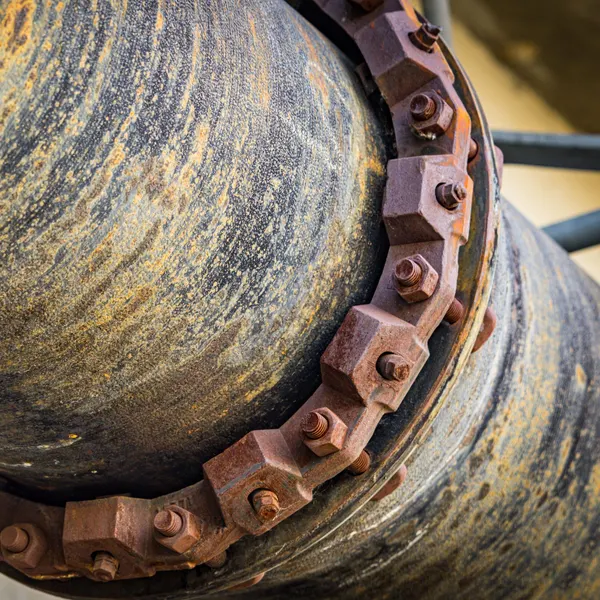
Cast iron does not fail at the joints the way clay does. It fails along the bottom. Wastewater flows in the bottom third of the pipe, and that channel is where the metal is attacked from the inside: by hydrogen sulfide from sewage, by acidic waste, by the constant wet-dry cycle. Three things happen over the decades.
- Scale and tuberculation. Rust does not flake away; it builds up as rough nodules that reduce the diameter and catch paper, grease and hair. A 4-inch pipe behaves like a 2-inch pipe.
- Channel corrosion. The bottom of the pipe thins until it is paper, then it is gone. Waste runs on the dirt under the slab. You do not see this from above; you smell it, or the floor drain backs up.
- Cracks and separated hubs. Cast iron is brittle. Slab movement, common on KC's expansive clay soils, cracks it or pulls the lead-and-oakum joints apart.
The average service life is 50 to 75 years. A 1955 pipe is 70 years old. Most cast iron in the metro is on borrowed time, and the question is what is left of it, not whether it will fail.
How we assess it
- Camera inspection from the cleanout in both directions: under the slab toward the fixtures and out toward the street. About the scope.
- Descale if needed. Heavy scale hides the pipe wall. A chain flail or descaling nozzle on the jetter removes it so the camera can see the actual condition. This is a repair in itself for many houses; flow is restored immediately.
- Second camera pass. Now we see the truth: intact wall, thin bottom, or no bottom. Each stretch is marked with distance from the cleanout.
- Written options. Descaling only, descaling plus lining, replacement of a section, or full replacement, each by the foot.
Options and what they cost
| Option | When | Price |
|---|---|---|
| Descaling only | Scale but sound wall; buys years | $600–$1,500 |
| Descale + cast iron pipe lining | Thin bottom, wall still continuous | $90–$220 per foot |
| Under-slab section replacement | Bottom gone in one stretch | $2,500–$7,000 per section |
| Full under-slab replacement | Bottom gone throughout | $150–$300 per foot ($8,000–$25,000) |
| Exterior lateral replacement | Cast iron outside the foundation | $50–$250 per foot |
Under-slab work costs more per foot than yard work because the trench is cut through concrete, dug by hand in a basement, and the floor is repoured. In a finished basement, add flooring and framing. The cost page has the full breakdown and a calculator.
Cast iron sewer pipe lining
Lining is the reason most cast iron replacements in Kansas City no longer require jackhammering the basement. After descaling, a cured-in-place liner is installed through the cleanout, same as for clay. It bonds to the rough iron and forms a new, smooth pipe with no joints. It handles thin walls and small holes. What it cannot do is span a long run with no bottom at all; the liner needs something to press against while it cures. That is the line between "line it" and "replace it," and only the post-descaling camera pass can draw it. More on lining.
When we do not recommend replacement
If descaling reveals a wall that is rough but continuous, we recommend descaling and, if the budget allows, lining, not replacement. If only the last few feet under the front wall are gone, a section replacement plus lining the rest costs a third of a full replacement. And if a homeowner is selling in a year, a descaling that restores flow and a clean camera video may be the right amount of money to spend. We do not sell full replacements to houses that need a cleaning.
Where we see it
Cast iron under the slab is standard in 1950s–70s housing across the metro: the ranch belts of Overland Park, Lee's Summit and Independence, Raytown, Gladstone, and postwar Kansas City, Kansas. If a backup is happening now, start there.
Frequently asked questions
How much does cast iron sewer line replacement cost in Kansas City?
Lining cast iron runs $90–$220 per foot after descaling. Replacing under-slab cast iron by trenching through the basement floor runs $150–$300 per foot including concrete removal and repour, typically $8,000–$25,000 for a whole house. Exterior cast iron laterals cost the same as clay to replace: $50–$250 per foot open-cut.
How long does cast iron sewer pipe last?
Fifty to seventy-five years in typical Kansas City conditions. Pipe from the 1950s is at or past the end of its service life; pipe from the early 1970s is getting there. Acidic soil, hot water use and a flat grade shorten it.
Can cast iron sewer pipe be lined?
Yes, if enough of the pipe wall remains to hold the liner during curing. We descale it first, then camera it. If the bottom channel is rusted through in long stretches, the liner has no support and replacement is the answer.
What are the signs of failing cast iron?
Slow drains throughout the house, a sewer smell in the basement, rust-colored water backing up in the floor drain, and, in the worst cases, a wet or sunken patch in the basement floor or a bad smell from a crack in the slab. On camera: rough flaking walls, a flat or missing bottom, and scale tubercles.
Is cast iron drain pipe covered by insurance?
Gradual corrosion is excluded by almost every policy. A sudden backup caused by the failure may be covered under a sewer backup endorsement. Utility warranty programs typically cover the exterior lateral, not under-slab pipe. Details on our insurance page.