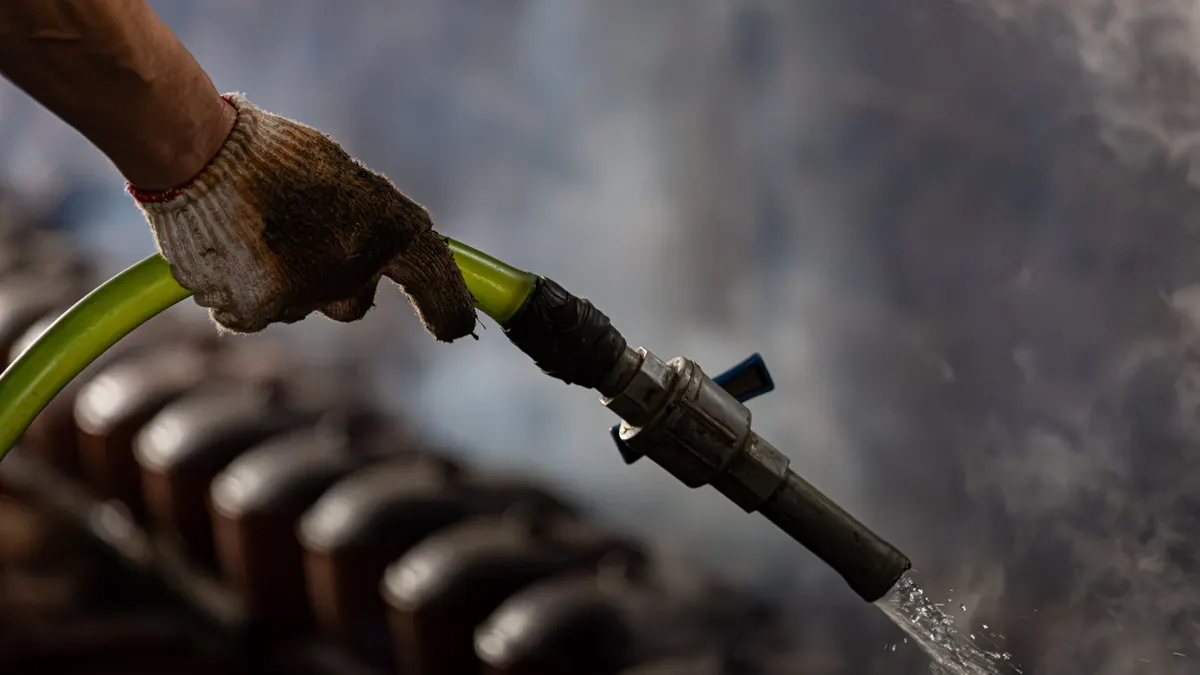
What sewer line cleaning by hydro jetting is
Hydro jetting is sewer cleaning with water instead of a cable. A hose with a specialized nozzle goes into the line through the cleanout. Rear-facing jets at 3,000 to 4,000 psi pull the hose forward and scour the pipe wall; a forward jet breaks up whatever is ahead of it. Roots are cut off flush at the joint, grease is emulsified and flushed to the main, and the scale that builds up in old cast iron is knocked loose. The pipe ends up at its full original diameter, which no cable can do.
A cable machine, the snake most drain cleaners bring first, drills a hole through the blockage. The water flows again and the truck leaves. The roots on the pipe wall stay, the grease coating stays, and the call comes again in six months. We cable when a cable is the right tool, for a soft clog close to the house. For the Kansas City lateral full of roots, jetting is the right tool.
When you need it
- Roots in the line, confirmed by camera or by the pattern: backups every spring or fall, slow drains that a cable fixes for a few months.
- Grease. Kitchen lines and laterals from houses with a lot of cooking build a grease layer that narrows the pipe by half. Water at pressure and temperature dissolves it.
- Scale in cast iron. Iron oxide tubercles catch paper and hair. Descaling with a chain flail or jetting nozzle restores flow, and it is required before lining cast iron.
- Preparation for lining. Every trenchless repair starts with a jetted, camera-verified pipe. A liner over roots or grease does not bond.
- Annual maintenance on a root-prone line you have chosen not to line yet, for example a house you plan to sell in two years.
How we do it
- Camera first. We look before we blast. Jetting a pipe that has a collapsed or badly fractured section can wash out the soil around it and make a repair bigger. If the camera cannot pass a blockage, we look at what we can and proceed carefully. About the inspection.
- Choose the nozzle. A penetrating nozzle for a full blockage, a root-cutting or chain nozzle for roots, a rotating nozzle for grease and scale. Pressure and flow are set for the pipe material and size.
- Jet from the cleanout toward the main. We work the hose in and out over each defect until the wall is clean, flushing debris downstream to the city main, never back toward the house.
- Jet from the house side if needed. With a basement cleanout and a yard cleanout we can clean both directions.
- Camera after. You see the difference on the monitor. This is also when we talk about what comes next: nothing, lining, a spot repair or a plan for a year from now.

What it costs
$350 to $900 for a residential lateral in Kansas City, including the camera pass afterward. The low end is a short, accessible line with moderate roots; the high end is a long line with heavy roots or scale, or one that needs cleaning from both ends. Emergency after-hours jetting adds $150. Simple cabling of a soft clog, when that is the right call, is $180 to $300. If jetting reveals that the pipe needs lining, the jetting cost is credited toward the lining because it was going to be part of that job anyway. Full price context on the cost page.
When we do not recommend hydro jetting
- The pipe has a collapse or a large fracture. High-pressure water through a broken section erodes the bedding. The section needs repair, not cleaning.
- Orangeburg pipe. This bituminous fiber pipe from the 1940s and 50s delaminates under pressure. It is a replacement in every case.
- A clog inside the house in a 1.5- or 2-inch branch line. A small cable clears it for a fraction of the price.
- The third time in two years. If we have jetted your line twice, a third jetting is money you should put toward lining. We will say so before we bring the hose out.
Kansas City service area
Sewer cleaning in Kansas City MO and KS, Overland Park, Olathe, Independence, Lee's Summit, Shawnee, Lenexa, Blue Springs, Raytown and Gladstone. If a backup is happening right now, the emergency page tells you what to do in the next ten minutes.
Frequently asked questions
How much does hydro jetting cost in Kansas City?
Residential sewer line cleaning by hydro jetting runs $350 to $900 depending on length, how heavy the roots or grease are, and access. That includes a camera pass after the jetting so you can see the result.
Is hydro jetting safe for old clay pipe?
Yes, when the pressure and nozzle are matched to the pipe. We scope first. Clay in sound condition handles jetting well; if the camera shows a fractured or collapsed section we do not jet through it, because water at 4,000 psi will make a bad section worse.
What is the difference between cabling (snaking) and hydro jetting?
A cable drills a hole through the blockage so water flows again. Jetting scours the whole inside of the pipe back to the wall. Cabling is cheaper and right for a soft clog. Jetting is right for roots, grease and scale, and it lasts far longer.
How often should a sewer line be cleaned?
If the line has root intrusion and you have decided not to line it yet, once a year, ideally before the spring growth. A lined or new PVC line should not need routine cleaning at all.
Can hydro jetting remove tree roots permanently?
No. It removes the roots that are there. They come back through the same joints, usually within a year or two. Lining seals the joints and is the permanent fix; jetting is the preparation for it.