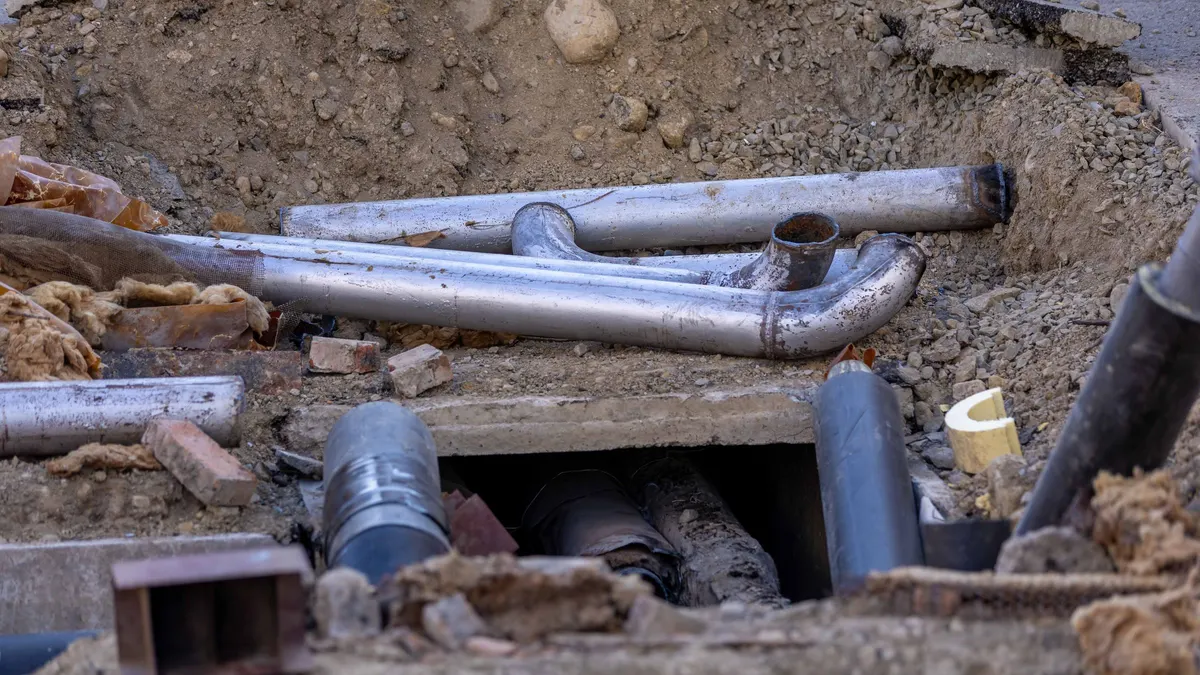
What trenchless sewer repair is
Trenchless sewer repair fixes a broken sewer line from the inside. Instead of digging a trench from the house to the street, we access the pipe through an existing cleanout, clean it back to bare wall, and install a cured-in-place pipe (CIPP) liner. The liner is a felt tube saturated with epoxy resin. It is inverted or pulled into the old pipe, inflated against the walls, and cured with hot water or steam. A few hours later there is a seamless, jointless pipe inside the old clay or cast iron, and the yard looks exactly the way it did in the morning.
In Kansas City this matters more than in most cities. The majority of homes inside the I-435 loop were built before 1975 and drain through vitrified clay pipe in 3-foot sections, under mature oaks, maples and sycamores. The pipe itself is usually still sound. The joints are not. Lining seals every joint at once without touching a single tree root above ground.
When you need it
Trenchless sewer line repair is the right call when the camera shows any of these:
- Root intrusion at several joints along the run.
- Longitudinal or circumferential cracks with the pipe still holding its round shape.
- Leaking or slightly offset joints (under about half an inch).
- Scale and channel corrosion in cast iron where the bottom of the pipe is thin but not gone.
- A line under something expensive: a new driveway, a patio, a finished basement floor, a mature tree, a city sidewalk.
Recurring backups that clear with a cable and come back six months later are the classic sign. The cable cuts the roots; it does not close the door they came through.
How we do it, step by step
- Camera inspection. We scope the line from the cleanout to the city main and record it. You watch with us. We measure the run in feet and note the depth and location of every defect. This is where we decide whether lining is possible at all. More on the inspection.
- Hydro jetting. A high-pressure nozzle cuts roots and scale back to the pipe wall. A liner bonded to grease or roots fails, so we do not skip this. How jetting works.
- Second camera pass. We confirm the pipe is clean, continuous and round. If this pass shows a belly, a collapse or a badly offset joint, we stop and tell you. See "when we do not recommend it" below.
- Liner measurement and wet-out. The felt liner is cut to the exact length of your run and saturated with resin on site or in the truck.
- Installation. The liner is inverted with air pressure through the cleanout and travels to the main. A calibration bladder inflates it tight against the old pipe.
- Curing. Hot water or steam circulates for two to four hours until the resin hardens. The line is out of service during this time; we tell you in advance so you can plan around it.
- Reinstating connections. If a branch line (a basement bathroom, for example) ties into the lateral, a robotic cutter reopens it from the inside.
- Final camera and footage. You get a recording of the finished liner, the written warranty, and an invoice that matches the quote.
What it costs in Kansas City
Sewer pipe lining in Kansas City runs $80 to $200 per linear foot. For a typical lateral of 40 to 80 feet, expect $4,000 to $12,000 including cleaning, both camera passes and the warranty. What moves the number:
- Diameter. A 4-inch residential line is the base price; 6-inch lines cost more in liner and resin.
- Length. Longer runs cost more in total but less per foot, since setup is the same.
- Access. An existing cleanout is ideal. Installing one adds $400 to $1,200.
- Condition. Heavy roots or scale mean more jetting time.
- Branch connections. Each reinstated tie-in adds a robotic cut.
Compare that with open-cut replacement at $50 to $250 per foot plus the cost of restoring whatever was on top. The cost page has the full comparison and a calculator you can run with your own numbers.
Pipe lining vs. replacement: pros and cons
| Factor | Trenchless lining | Open-cut replacement |
|---|---|---|
| Digging | None with a cleanout | Full trench, house to main |
| Time | One day | Two to five days plus restoration |
| Fixes bellies | No | Yes |
| Fixes collapse | No | Yes |
| Diameter | Loses ~¼ inch, gains smooth flow | New full-size pipe |
| Landscaping, driveway | Untouched | Replaced at extra cost |
| Warranty | 25 years | Lifetime on PVC pipe, 5 years on workmanship |
When we do not recommend trenchless repair
Honesty here is what keeps a $9,000 job from becoming a $9,000 mistake. We will not line a pipe if the camera shows:
- A belly. A liner follows the host pipe. If the old pipe sags and holds water, the lined pipe sags and holds water. The section needs to be dug and re-bedded at grade.
- A collapse or a missing section. The liner has nothing to press against. Pipe bursting or excavation is the fix.
- An offset joint over about half an inch. The liner will bridge it, but it thins and wrinkles at the step. We prefer a spot repair at that joint and lining the rest.
- A pipe that is already undersized for the house, for example a 3-inch line feeding three bathrooms. Losing another quarter inch is the wrong direction; bursting to 4-inch is right.
Roughly one in four lines we scope in Kansas City falls into one of these. When it does, you get the footage, the reason, and a price for the method that will actually work.
Trenchless sewer repair across the metro
We line pipe on both sides of the state line: Kansas City, MO and KS, Overland Park, Olathe, Independence, Lee's Summit, Shawnee, Lenexa, Blue Springs, Raytown and Gladstone. Permits differ by city; we pull them and schedule the inspection. Before lining a line that runs under the public right-of-way, check who is responsible for which part of the lateral in your city.
Frequently asked questions
How long does trenchless sewer lining last?
A properly installed cured-in-place liner is rated for 50 years by most manufacturers. We back ours with a 25-year written warranty on the liner and the installation.
Can trenchless sewer repair fix a belly?
No. A belly is a low spot where the pipe has settled and water pools. A liner follows the shape of the host pipe, so the low spot stays. Bellies need the section dug up and re-bedded at the right grade. If the camera shows standing water, we will tell you lining is not the answer.
Does pipe lining reduce the diameter of the pipe?
By about a quarter inch. A 4-inch clay line becomes roughly a 3.75-inch smooth pipe. Because the new surface has no joints or roughness, flow capacity is usually equal or better than the old pipe.
How much does sewer pipe lining cost in Kansas City?
Between $80 and $200 per foot depending on diameter, depth, access and how much cleaning the pipe needs first. A typical 60-foot house lateral lands between $4,000 and $12,000. The camera inspection gives you a written number by the foot.
Can you line a pipe that has tree roots in it?
Yes, once the roots are cut out. We hydro jet the line to bare pipe wall, run the camera again to confirm the pipe is round and continuous, then install the liner. The cured liner has no joints, so roots have nowhere to get back in.
Will you need to dig at all?
Usually not. Most Kansas City homes have a cleanout in the basement or yard that gives us access. If there is no cleanout, we install one, which means one small hole rather than a trench.