What pipe bursting is
Pipe bursting is trenchless sewer line replacement. Where lining puts a new pipe inside the old one, bursting removes the old one from the equation. We dig a pit at each end of the run, typically one at the house foundation or cleanout and one near the property line or the city tap. A steel cable or a rod string is fed through the old pipe. A hardened bursting head, larger than the old pipe, is attached at the far end with a new high-density polyethylene (HDPE) pipe behind it. A hydraulic unit in the receiving pit pulls the head through. The old clay or cast iron fractures outward into the surrounding soil and the new pipe slides into the space in a single, continuous pull.
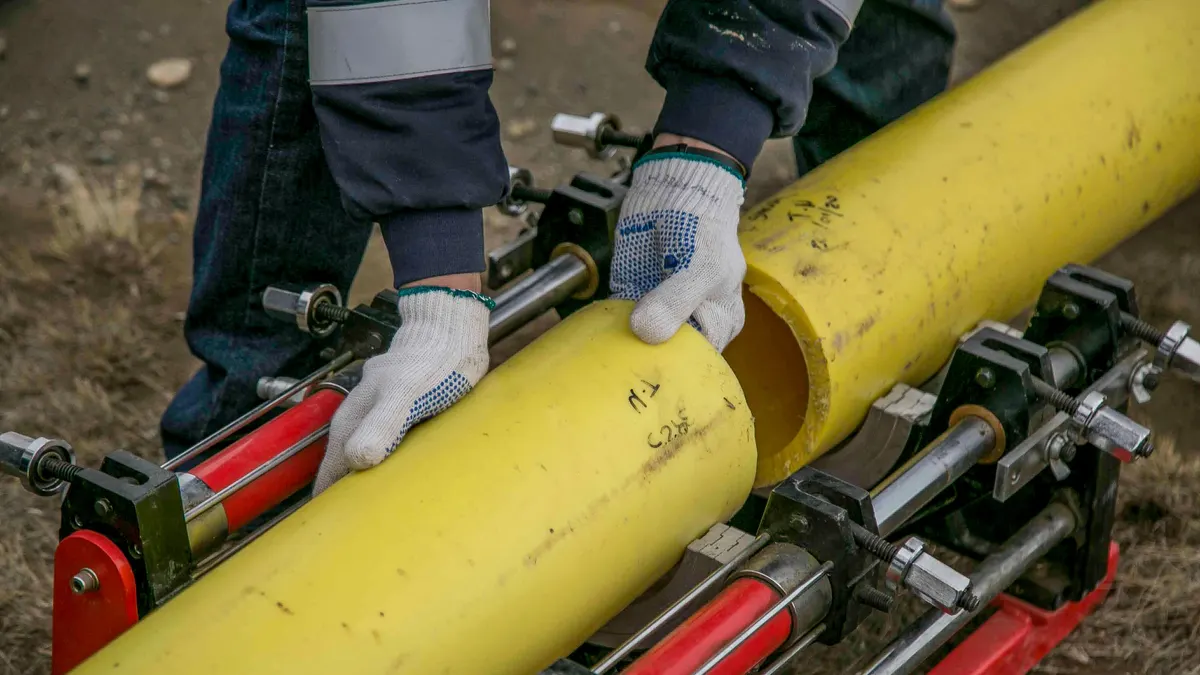
The HDPE arrives in sticks that we butt-fuse on site into one piece the length of your lateral. No joints means no place for roots to get in, ever. That, and the fact that you can go up a pipe size, are why this is often the best long-term answer for a Kansas City house with a collapsed clay line.
When you need it
- The old pipe has collapsed in one or more places, so a liner has nothing to press against.
- The pipe is undersized. Older homes with 3-inch laterals and modern water use. Bursting to 4-inch fixes capacity; lining would make it worse.
- The pipe is badly deteriorated end to end, for example thin-wall cast iron with the bottom rotted through, or Orangeburg.
- The line runs under something you do not want to dig up: a driveway, a garage slab, a retaining wall, a mature tree, the city sidewalk.
- The route is reasonably straight with no bends over 22 degrees. Bursting heads do not turn corners.
How we do it, step by step
- Camera inspection and locating. We scope the line, confirm it can be traversed by the cable, map the route and depth, and check for bends. About the inspection.
- Utility locates. Gas, water, electric, fiber are marked. Any utility within a foot of the sewer is hand-exposed.
- Permits. Kansas City MO, KCK and each Johnson County city have their own; we pull them and schedule the inspection.
- Two pits. Roughly 3 by 4 feet at the surface, down to the pipe. One at the house end (or where the cleanout will go), one at the downstream end. If the connection at the main is under the street, the downstream pit is often at the property line and the last few feet are handled with the city's requirements.
- Fuse the HDPE. The new pipe is butt-fused into a single length and pressure-checked.
- Pull. The bursting head and new pipe are pulled through. A 60-foot lateral usually takes under an hour once set up.
- Connect and test. New cleanout at the house, transition fitting to the city tap, water test.
- Backfill and restore. Pits are compacted in lifts, topsoil and sod replaced, concrete patched if a pit was in the driveway.
What pipe bursting costs in Kansas City
Pipe bursting sewer line replacement in Kansas City runs $90 to $220 per foot. A typical 50- to 80-foot residential run comes to $6,000 to $15,000. That is more per foot than lining and usually less than open-cut replacement once restoration is counted. Price drivers:
| Factor | Effect on price |
|---|---|
| Depth of the pits | Pits over 8 feet need shoring; adds $800–$2,000 |
| Pit location | Lawn is cheapest; driveway or sidewalk adds concrete restoration |
| Upsizing | 4-inch to 6-inch adds 10–20% |
| Connection at the main | Under the street, with traffic control: adds $1,500–$4,000 |
| Soil | Rock or dense clay slows the pull; KC's limestone shelves matter here |
| Length | Longer is cheaper per foot; setup is the same |
Run your own numbers on the cost calculator. The camera inspection replaces the range with one written price.
Bursting vs. lining vs. digging
Three tools for three situations. Lining is right when the pipe is round, continuous and correctly sized: cheapest, one day, no digging at all. Bursting is right when the pipe is collapsed, undersized or shot end to end but the route is straight: a new pipe, two pits. Open excavation is right when there is a belly to regrade, a route that bends, or a section under the slab where the pits would be inside the house anyway. We carry equipment for all three, so the recommendation is not driven by which truck we own.
When we do not recommend pipe bursting
- A belly. The new pipe follows the old alignment. If the old pipe sags, the new one sags. Bellies need a dug section re-bedded at grade.
- Bends over 22 degrees. The head cannot follow them. Some laterals bend to go around a foundation corner; those sections are dug.
- Previously lined or repaired pipe with steel bands or concrete encasement. The head may not fracture them evenly.
- Utilities within inches of the sewer along the run, which happens with old gas services laid in the same trench. Expose and dig instead.
- A pipe that could simply be lined. If the camera shows a sound host pipe, lining does the job for less and we will say so.
Across the Kansas City metro
Pipe bursting in Kansas City MO and KS, Overland Park, Olathe, Independence, Lee's Summit, Shawnee, Lenexa, Blue Springs, Raytown and Gladstone. Where the lateral crosses the public right-of-way, rules on who owns which part differ by city; we handle the paperwork.
Frequently asked questions
What is pipe bursting sewer line replacement?
A trenchless method that replaces the old pipe rather than lining it. A cone-shaped bursting head is pulled through the old line by a cable or rod from a small pit at one end. It fractures the clay or cast iron outward into the soil while a new HDPE pipe attached behind it takes its place.
How much does pipe bursting cost in Kansas City?
$90 to $220 per foot, or $6,000 to $15,000 for a typical residential lateral, including the two access pits, the fused HDPE pipe, reconnection at both ends and backfill. Depth and what is at the two ends move the price most.
Can you upsize the pipe with bursting?
Yes, by one size in most soils. A 3-inch or 4-inch line can become 4-inch or 6-inch. That is one of the main reasons to choose bursting over lining, which slightly reduces the diameter.
Will pipe bursting damage other utilities?
The soil displacement is a few inches around the pipe. We locate gas, water and electric lines before any work and keep clearance. Where a utility crosses within a foot of the sewer, we expose it by hand first.
How long does the new HDPE pipe last?
HDPE has no joints in the run, does not corrode and is not attacked by roots. Manufacturers rate it for 100 years. We give a lifetime warranty on the pipe and 10 years on the workmanship.